Table of contents
Key points
- A CP12 certificate is the common name for a Landlord Gas Safety Record (LGSR), the document issued after an annual gas safety check.
- Landlords must have every gas appliance, fitting and flue they provide checked by a Gas Safe registered engineer at least every 12 months.
- Tenants must get a copy within 28 days of the check, and new tenants before they move in.
- You can renew up to two months early and keep your original expiry date.
- Failing to arrange a gas safety check is a criminal offence.
If you let a property with a gas boiler, gas hob or gas fire, the CP12 is the most important certificate you hold. It is also the one most often confused, with landlords, agents and tenants using several different names for the same document. This guide explains exactly what a CP12 is, what the law requires, and how to stay compliant every year.
What is a CP12 certificate?
A CP12 certificate is a record showing that the gas appliances, pipework and flues in a rented property have been checked and found safe, or that any problems have been identified, by a Gas Safe registered engineer.
The official name is a Landlord Gas Safety Record, often shortened to LGSR. Most people simply call it a gas safety certificate. All three names describe the same document.
What does CP12 stand for?
CP12 stands for CORGI Proforma 12. CORGI was the official register of gas engineers until April 2009, when it was replaced by the Gas Safe Register. The form number stuck, so “CP12” is still widely used today, even though the record is now issued by Gas Safe registered engineers.
CP12 vs gas safety certificate vs LGSR
| Name | Where it comes from | Same document? |
|---|---|---|
| CP12 | Old CORGI form number | Yes |
| Landlord Gas Safety Record (LGSR) | Official name used today | Yes |
| Gas safety certificate | Everyday name used by landlords and agents | Yes |
Who needs a CP12?
Under the Gas Safety (Installation and Use) Regulations 1998, landlords must arrange an annual gas safety check for any property let as a home where they supply gas appliances, fittings or flues. This includes:
- Houses and flats let on assured shorthold or other residential tenancies
- Houses in multiple occupation (HMOs) and bedsits
- Student accommodation
- Holiday lets and short-term lets
- Rooms let to lodgers
The duty usually falls on the landlord, but a letting or managing agent can take on responsibility through the management agreement. Make sure it is clear in writing who is arranging the check.
Gas appliances owned by the tenant are not covered by the landlord’s check, although the landlord remains responsible for the pipework and for any flues serving their own appliances. Commercial premises have similar duties, covered by a commercial gas safety certificate.
What does a CP12 gas safety check cover?
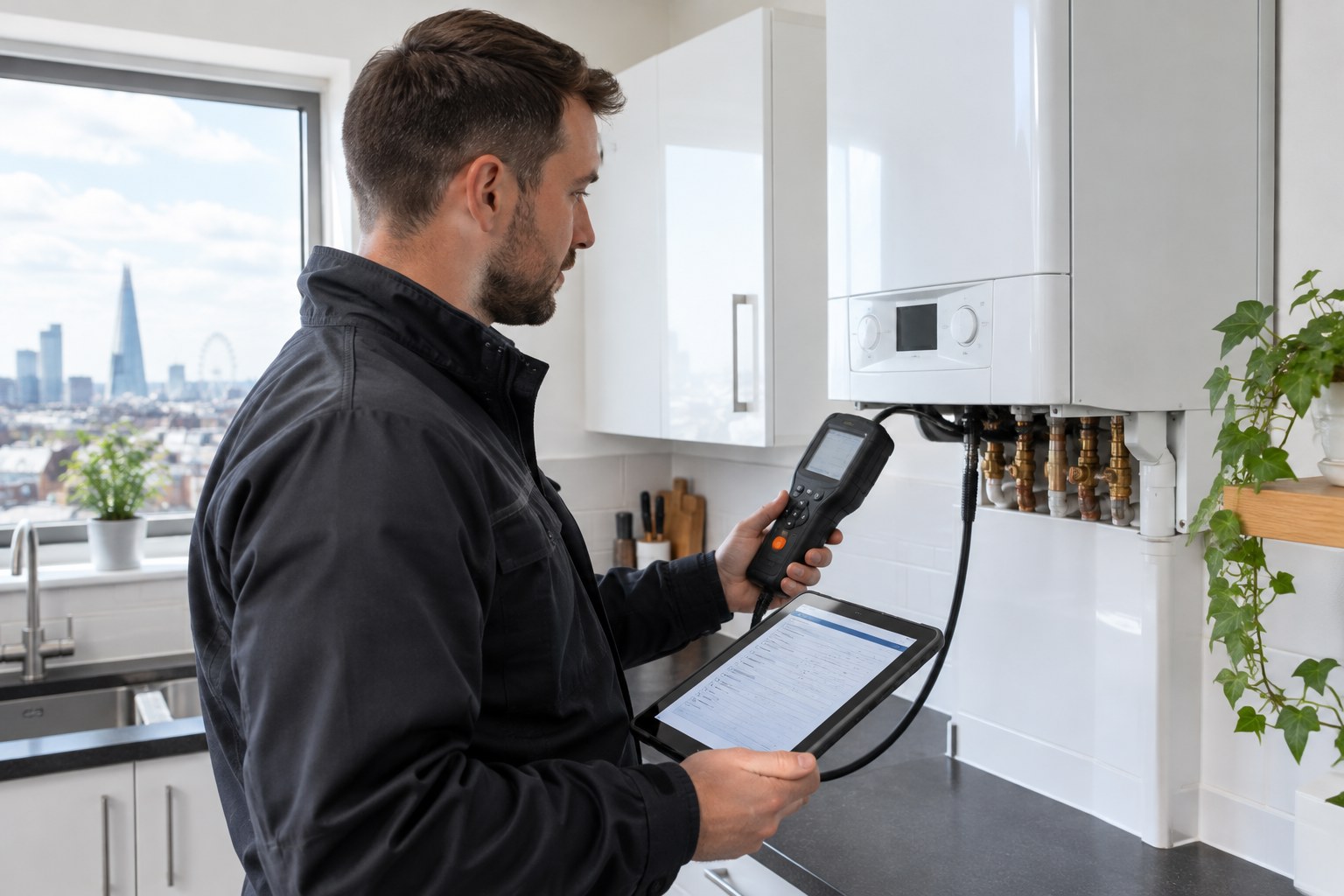
A Gas Safe engineer checks every gas appliance and flue the landlord provides, such as boilers, gas hobs and cookers, and gas fires. The check normally includes:
- Gas tightness of the installation, to check for leaks
- Burner pressure or gas rate against the manufacturer’s data
- Ventilation, to make sure appliances have enough air to burn safely
- Flues and chimneys, to check fumes are removed safely
- Safety devices, such as flame failure devices, are working
- A visual inspection of the appliance and its installation
What a CP12 record shows
- The property address and the landlord or agent’s details
- Each appliance checked, its location and the results
- Any defects found and the action taken
- The engineer’s name, signature and Gas Safe registration number
- The date of the check
Need a CP12 in London?
Gas safety certificates from £55 for one appliance, carried out by Gas Safe registered engineers, with a digital certificate.
How long does a CP12 certificate last?
A CP12 is valid for 12 months. Landlords must make sure a new gas safety check is carried out within 12 months of the last one.
Since April 2018, you can have the check done up to two months before the deadline and keep the original expiry date. For example, if your current record runs out on 30 June, a check carried out on 15 May will still run until 30 June next year. This makes it much easier to arrange access without losing months of cover.
You must keep each gas safety record for at least two years, or until two further checks have been carried out if you use the two-month window.
Landlord gas safety duties
- Annual check: have every gas appliance, fitting and flue you provide checked by a Gas Safe registered engineer at least every 12 months.
- Existing tenants: give them a copy of the record within 28 days of the check.
- New tenants: give them a copy before they move in. For short lets of under 28 days, you can display a copy in the property.
- Maintenance: keep pipework, appliances and flues in safe condition between checks.
- Records: keep each record for at least two years.
- Carbon monoxide alarms: fit a CO alarm in any room with a fixed combustion appliance, such as a gas boiler or gas fire (gas cookers are excluded). See our fire safety guide for the alarm rules.
Always check the engineer is Gas Safe registered and qualified for the type of appliance. You can ask to see their Gas Safe ID card and check their number on the Gas Safe Register website.
What happens if an appliance fails?
If the engineer finds a problem, they classify it under the industry’s unsafe situations procedure:
| Classification | Meaning | What happens |
|---|---|---|
| Immediately Dangerous (ID) | An immediate risk to life or property | The appliance is disconnected with your permission and labelled “Do not use” until repaired |
| At Risk (AR) | One or more faults that could become dangerous | The appliance is usually turned off and labelled until the fault is fixed |
| Not to Current Standards (NCS) | Not dangerous, but does not meet current standards | Recorded as advice. Improvement is recommended but not urgent |
If an appliance is classed as ID or AR, it must not be used until it has been repaired by a Gas Safe engineer. Arrange repairs quickly, as tenants may be left without heating or hot water, and keep evidence that the work was done.
Common reasons for failing a gas safety check
Most failures are caused by a small number of familiar problems. Knowing them helps you plan maintenance and avoid surprises on the day:
- Poor combustion or flue problems, where fumes are not being removed safely, often caused by a blocked, damaged or incorrectly installed flue.
- Inadequate ventilation, for example air vents that have been blocked or covered by tenants, or appliances fitted in small rooms without enough air supply.
- Gas leaks found during the tightness test, often from old fittings or damaged pipework.
- Faulty flame failure devices on gas hobs and fires, which should cut off the gas if the flame goes out.
- Old or poorly maintained gas fires, particularly back boilers and decorative fuel effect fires that have not been serviced.
- Boilers that have not been serviced for several years and are showing signs of wear or incomplete combustion.
An annual boiler service alongside the gas safety check is the simplest way to reduce the chance of an appliance failing, keep repair costs down and extend the life of the boiler.
Penalties for not having a CP12
Failing to carry out an annual gas safety check is a criminal offence enforced by the Health and Safety Executive (HSE). Landlords can face unlimited fines and, in serious cases, imprisonment. If a tenant is harmed, the consequences can be far more serious, including manslaughter charges.
Missing or out-of-date certificates can also put you in breach of your mortgage, insurance or HMO licence conditions, and councils may take enforcement action.
How much does a CP12 cost?
The price mainly depends on how many gas appliances need checking. Landlord Sure’s fixed London prices are:
| Service | Price |
|---|---|
| Gas safety certificate, 1 appliance | £55 |
| Gas safety certificate, 2 appliances | £65 |
| Gas safety certificate, 3 appliances | £75 |
| Gas safety certificate, 4 appliances | £80 |
| Gas safety check and boiler service | £89.99 |
| Add PAT testing (up to 10 appliances) | £54.99 |
A combi boiler and a gas hob count as two appliances. You can add an EICR, EPC or PAT testing to the same visit.
How to get a CP12: step by step
- Check your expiry date and book within the two-month window to keep it.
- Count your gas appliances, such as the boiler, hob and any gas fires.
- Book a Gas Safe registered engineer through our online booking page.
- Arrange access with your tenants, giving proper notice. Keep records of your attempts if access is refused.
- The check takes place, usually in under an hour for a typical home.
- Receive your digital CP12 and send a copy to your tenants within 28 days.
- Set a reminder for next year’s check.
What if a tenant refuses access?
You must show you have taken all reasonable steps to carry out the check. Keep a written record of every attempt, such as letters, emails and appointment times offered. Repeated, documented attempts help show you have met your duty, but you should never enter without the tenant’s agreement except in an emergency.
Frequently asked questions
What is a CP12 certificate?
A CP12 is a Landlord Gas Safety Record. It shows that the gas appliances, pipework and flues in a rented property have been safety checked by a Gas Safe registered engineer.
Is a CP12 the same as a gas safety certificate?
Yes. CP12, Landlord Gas Safety Record (LGSR) and gas safety certificate all describe the same document.
What does LGSR mean?
LGSR stands for Landlord Gas Safety Record, the official name for the CP12 issued after the annual gas safety check.
How long does a gas safety certificate last?
12 months. You can renew up to two months early and keep the original expiry date.
Do I need a CP12 if the property has no gas?
No. If there is no gas supply or gas appliances, you do not need a gas safety record. You will still need an EICR and an EPC.
Do homeowners need a CP12?
No. The legal requirement applies to landlords. Homeowners are advised to have gas appliances checked and serviced regularly, but a CP12 is not required.
Can I do my own gas safety check?
No. Only a Gas Safe registered engineer can carry out the check and issue a Landlord Gas Safety Record.
How long does a gas safety check take?
Most homes take between 30 minutes and an hour, depending on the number of appliances.
Book your CP12 with Landlord Sure
Fixed prices from £55, Gas Safe registered engineers and digital certificates. Add a boiler service, EICR or EPC to the same visit.
Sources: HSE – Landlord gas safety record; HSE – Gas safety: landlords and letting agents; Gas Safe Register. Information checked October 2026. This guide is general information, not legal advice.