Table of contents
Key points
- Emergency lighting should have a monthly functional test and an annual full-duration test, following BS 5266-1.
- The monthly test is a short “flick test” that anyone trained can do. The annual test runs the lights for their full rated duration, usually three hours.
- Every test, fault and repair should be recorded in an emergency lighting log book.
- Emergency lighting is usually needed in HMOs, the common parts of blocks of flats and commercial premises, as identified by the fire risk assessment.
- Responsible persons who fail to maintain fire safety equipment can face unlimited fines under the Fire Safety Order.
Emergency lights are easy to forget about, because they sit quietly on the ceiling until the moment they are needed. When the power fails during a fire, they light the escape route so people can get out safely. If the batteries have failed or the lamps are dead, that escape route goes dark.
This guide explains exactly how often emergency lighting should be tested, how to carry out the tests, who can do them and what records you need, so you can stay compliant and keep people safe.
What is emergency lighting?
Emergency lighting is lighting that switches on automatically when the normal power supply fails. It is powered by a battery, either inside each light fitting or from a central battery system, and is designed to help people leave a building safely.
Types of emergency lighting
| Type | What it does |
|---|---|
| Escape route lighting | Lights corridors, stairs and exits so people can find their way out |
| Open area (anti-panic) lighting | Lights larger open spaces so people can reach an escape route |
| High-risk task area lighting | Allows dangerous processes to be shut down safely |
| Illuminated exit signs | Show the direction of the nearest exit |
Maintained vs non-maintained
- Maintained fittings are on all the time and stay on when the power fails. They are common in places of entertainment and buildings used at night.
- Non-maintained fittings only come on when the power fails. They are the most common type in residential blocks, HMOs and offices.
Most buildings use self-contained fittings, each with its own battery. Larger buildings may use a central battery system that powers many fittings from one location.
Who needs emergency lighting?
The Regulatory Reform (Fire Safety) Order 2005 requires the responsible person for non-domestic premises, including the common parts of multi-occupied residential buildings, to provide emergency lighting where it is needed and keep it maintained. Whether it is needed is decided by the fire risk assessment.
| Property type | Emergency lighting usually needed? |
|---|---|
| Single house or flat let to one household | Not normally |
| Small HMO with a short, simple escape route | Sometimes, depending on the fire risk assessment |
| Larger HMO, or one with long or complex escape routes | Usually yes, on escape routes and stairs |
| Common parts of a block of flats | Usually yes, on corridors and stairwells without good natural light |
| Offices, shops, restaurants and other commercial premises | Yes, in most cases |
| Hotels, care homes and other sleeping accommodation | Yes |
If you are not sure whether your building needs emergency lighting, a domestic fire risk assessment or commercial fire risk assessment will tell you.
How often should emergency lighting be tested?
The British Standard for emergency lighting, BS 5266-1, together with the testing standard BS EN 50172, sets out two routine tests:
| Test | How often | What it involves | Who usually does it |
|---|---|---|---|
| Functional (flick) test | Monthly | Short simulated power failure to check every light and sign comes on | The responsible person or a trained member of staff |
| Full-duration test | Annually | Lights run on battery for their full rated duration, usually 3 hours | A competent engineer |
In addition, a daily visual check of any central battery system indicators is recommended, and lights should be checked after any building work or electrical alterations.
Need emergency lighting tested in London?
Emergency light testing and certification from £60 for 1 to 3 lights, for HMOs, blocks of flats and commercial premises.
How to test emergency lighting: step by step
The monthly functional test
- Tell occupants that a test is taking place, so nobody thinks there is a real power cut.
- Find the test switch. This is usually a key switch, often called a “fish key” or “emergency light test key” switch, near the distribution board or the light fittings.
- Simulate a mains failure by turning the key or isolating the lighting circuit. This cuts power to the charging circuit without cutting the lighting circuit itself.
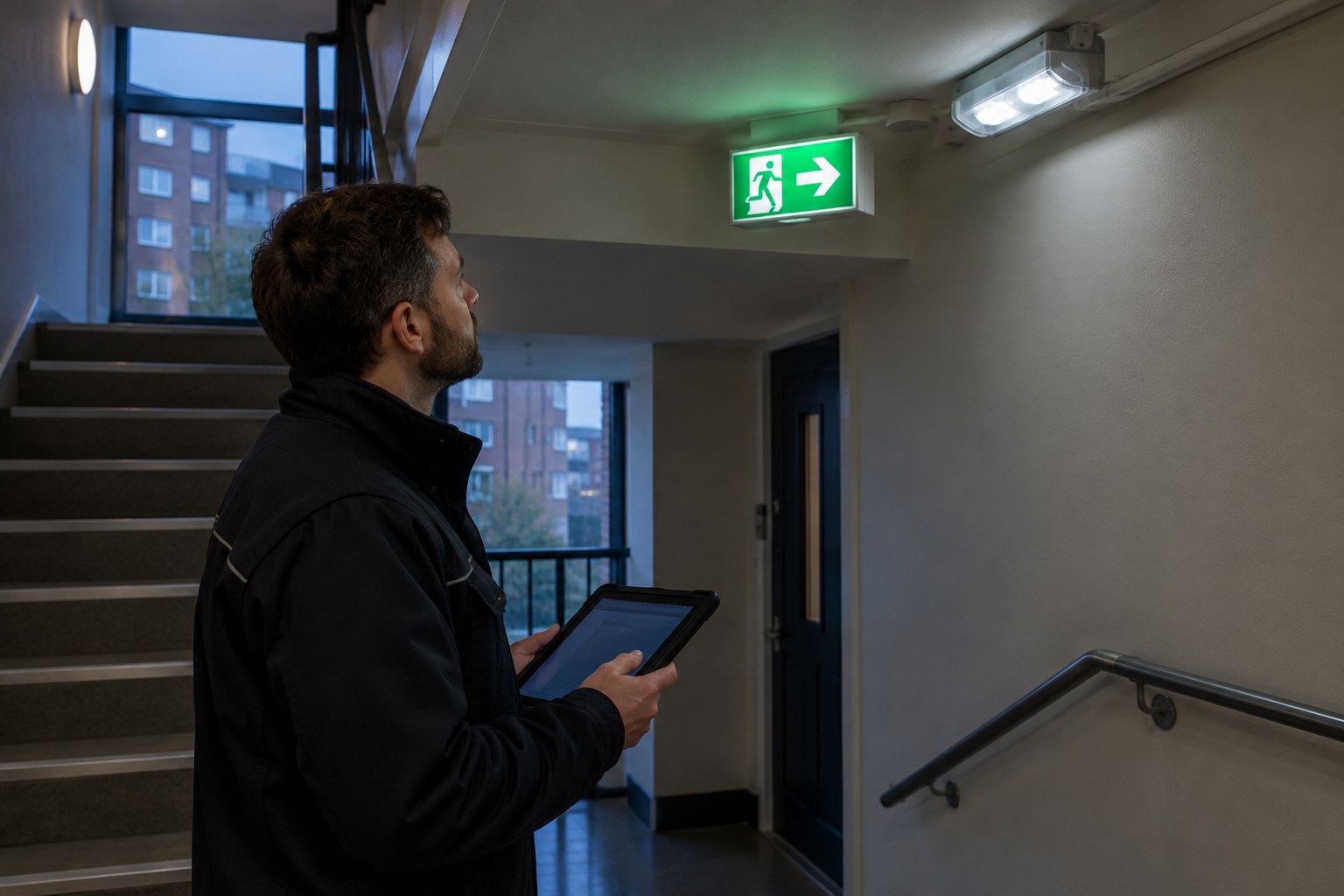
- Walk the building and check every emergency light and exit sign has switched on and is working properly.
- Keep the test short. A few minutes is enough. Long tests drain the batteries unnecessarily.
- Restore the power and check each fitting’s charging indicator (usually a small green LED) is lit again.
- Record the results in the log book, including any faults found.
The annual full-duration test
- Plan the timing. After the test, batteries can take up to 24 hours to recharge, leaving the building with reduced emergency lighting. Test when the building is least occupied.
- Simulate a mains failure and leave the lights running on battery for their full rated duration, usually three hours.
- Check each fitting is still lit at the end of the test, and note any that dimmed or failed early.
- Restore power and confirm the fittings are charging.
- Replace failed batteries or lamps and retest those fittings.
- Issue a certificate and update the log book with the results.
In buildings where people sleep, such as HMOs, it is good practice to test alternate fittings on different days, so the building is never left with no charged emergency lighting at all.
Who can test emergency lighting?
The monthly functional test can be carried out by the responsible person, a landlord, a building manager or a trained member of staff, as long as they understand what to check and how to record it.
The annual full-duration test and any repairs should be carried out by a competent person, usually a qualified electrician or fire safety engineer who understands BS 5266 and can safely work on the fittings and circuits. They will also check the system is still suitable for the building and that light levels on escape routes are adequate.
Self-test emergency lighting
Many modern fittings have self-test or automatic testing functions. They run their own monthly and annual tests and show a fault indicator if something fails. Some larger systems report results to a central panel or online dashboard.
Self-test systems make compliance easier, but they do not remove the need for checks. Someone still needs to look at the indicators regularly, record the results and arrange repairs. An annual inspection by a competent person is still recommended.
Emergency lighting log book and records
Every emergency lighting system should have a log book. It should record:
- The date of every monthly and annual test
- The results, including any fittings that failed
- Faults found and the date they were repaired
- Any alterations to the system
- The name of the person who carried out each test
Fire and rescue service inspectors and HMO licensing officers often ask to see the log book. Up-to-date records are one of the simplest ways to show you are meeting your fire safety duties.
Common emergency lighting faults
- Batteries that no longer hold charge, so lights fail before the end of the three-hour test. Batteries typically need replacing every few years.
- Failed lamps or LED modules that do not light up at all.
- Charging indicators that are off, often due to a tripped circuit or a fault in the fitting.
- Missing or damaged exit signs, or signs pointing the wrong way after layout changes.
- Fittings painted over or obstructed during decoration or building work.
- Gaps in coverage after partitions, new rooms or new stairs are added.
Emergency lighting for landlords and HMOs
For landlords, emergency lighting is most often an issue in HMOs and in the common parts of converted houses and blocks of flats. National fire safety guidance for housing, used by many councils, links the need for emergency lighting to the length and complexity of the escape route and whether it has enough borrowed light from streetlights or windows.
Many London councils include emergency lighting and regular testing in their HMO licence conditions. If your HMO licence mentions emergency lighting, make sure tests are done and recorded, as missing records can be treated as a licence breach.
Emergency lighting is part of a wider set of fire precautions, including alarms, fire doors and clear escape routes. Our fire safety guide for landlords explains how these fit together.
How much does emergency lighting testing cost?
Costs depend on how many emergency lights the building has. Landlord Sure’s fixed London prices for emergency light testing and certification are:
| Number of lights | Typical building | Price |
|---|---|---|
| 1 to 3 lights | Small flats, maisonettes and small commercial units | £60 |
| 4 to 5 lights | Larger flats, houses, small HMOs and small shops or offices | £84 |
| 6 to 8 lights | HMOs and blocks with shared hallways, medium-sized commercial premises | £120 |
| 9 to 12 lights | Larger residential blocks and commercial buildings | £165 |
| Each additional light over 12 | Large buildings | £17 per light |
You can combine emergency lighting testing with a fire safety certificate or EICR in the same visit.
Frequently asked questions
How often should emergency lighting be tested?
A short functional test every month and a full-duration test, usually three hours, every year, in line with BS 5266-1.
How do you test emergency lighting?
Use the test key switch to simulate a power failure, check every emergency light and exit sign comes on, then restore power and confirm the charging indicators are lit. Record the results in the log book.
Who can test emergency lighting?
A trained responsible person or member of staff can do the monthly test. The annual full-duration test and any repairs should be done by a competent electrician or fire safety engineer.
Is emergency lighting a legal requirement?
The Fire Safety Order requires emergency lighting where the fire risk assessment shows it is needed, which includes most commercial premises, many HMOs and the common parts of many blocks of flats.
Do I need emergency lighting in a rented flat?
Not normally inside a single flat. It is more likely to be needed in the shared corridors and stairs of the building, which are the responsibility of the freeholder or managing agent.
How long should emergency lights last?
Most fittings are rated for three hours, which is expected in residential buildings and anywhere people sleep.
Do self-test emergency lights need checking?
Yes. Someone still needs to check the indicators, record results and arrange repairs, and an annual inspection by a competent person is recommended.
What is an emergency light test key?
It is the key used in a key switch to simulate a mains failure for testing, without switching off the normal lighting circuit.
Book emergency lighting testing with Landlord Sure
Fixed prices from £60, qualified engineers, BS 5266 compliance checks and digital certificates. Add a fire door inspection, fire extinguisher service or fire risk assessment to the same visit.
Sources: Fire Protection Association – How often should emergency lighting be tested?; BAFE – Emergency lighting system guidance; BS 5266-1 and BS EN 50172. Information checked October 2026. This guide is general information, not legal advice.