Table of contents
Key points
- In England there is no single legal document called a “fire safety certificate” for most rented homes. The old fire certificate system ended in 2006.
- Landlords still have clear legal fire safety duties: smoke and carbon monoxide alarms in every let, and a fire risk assessment for HMOs and the common parts of blocks of flats.
- A fire safety certificate is the written evidence that your alarms, fire doors, emergency lighting and other fire precautions have been inspected and are working.
- Most landlords arrange an inspection once a year, at the start of each tenancy, and after any building work.
- Penalties for getting it wrong range from £5,000 fines for missing alarms to unlimited fines under fire safety law.
“Do I need a fire safety certificate?” is one of the most common questions we hear from London landlords and letting agents. The honest answer is that the law does not usually ask for a certificate by that name. It asks for something more practical: that you keep your tenants safe from fire, and that you can prove it.
That proof is what a fire safety certificate gives you. This guide explains exactly which fire safety rules apply to your property, what an inspection covers, how it differs from a fire risk assessment, and how to stay compliant without paying for things you don’t need.
What is a fire safety certificate?
A fire safety certificate is a document issued after a competent person has inspected the fire safety measures in a property and confirmed they are present and working. Depending on the building, an inspection usually covers:
- Smoke alarms and heat alarms, including interlinked systems
- Carbon monoxide alarms
- Fire alarm panels and call points in larger buildings
- Fire doors, door closers, seals and signage
- Emergency lighting along escape routes
- Fire extinguishers and fire blankets
- Escape routes, to make sure they are clear and usable
The certificate records what was checked, the results, and any defects or recommendations. For a landlord, it works as dated evidence that you have taken your fire safety duties seriously, which matters if a tenant complains, the council inspects or there is ever an incident.
Do I need a fire safety certificate? And what replaced them?
Not as a single named document. Under the old Fire Precautions Act 1971, some premises needed a fire certificate issued by the local fire authority.
What replaced fire safety certificates in 2005?
Fire certificates were replaced by the Regulatory Reform (Fire Safety) Order 2005, which came into force on 1 October 2006. Instead of the fire authority issuing a certificate, the Order made the “responsible person” (usually the employer, owner, landlord or managing agent) legally responsible for assessing fire risk and managing it themselves, mainly through a fire risk assessment. Existing fire certificates stopped having any legal effect.
So while you will not find a law that says “every landlord must hold a fire safety certificate”, you will find several laws that require you to install, test and maintain fire safety equipment, and in many buildings to carry out a written fire risk assessment. A fire safety certificate is the simplest way to show you have met those duties.
Fire safety laws that apply to landlords
Smoke and Carbon Monoxide Alarm Regulations
Since 1 October 2022, private and social landlords in England must:
- Fit at least one smoke alarm on every storey used wholly or partly as living accommodation
- Fit a carbon monoxide alarm in any room used as living accommodation that contains a fixed combustion appliance, such as a gas boiler or wood burner (gas cookers are excluded)
- Check alarms are working on the first day of each new tenancy
- Repair or replace faulty alarms once told about them
Regulatory Reform (Fire Safety) Order 2005
The Fire Safety Order applies to the common parts of multi-occupied residential buildings, such as shared hallways and stairwells in blocks of flats, and to most HMOs. The responsible person, often the landlord, freeholder or managing agent, must carry out a fire risk assessment, put fire precautions in place and keep them maintained. The Fire Safety Act 2021 confirmed that this includes the building’s structure, external walls and flat entrance doors.
Fire Safety (England) Regulations 2022
These regulations, in force since 23 January 2023, add duties for responsible persons in multi-occupied residential buildings. In buildings with two or more sets of domestic premises, residents must be given fire safety instructions and information about fire doors. In buildings over 11 metres, communal fire doors must be checked at least every three months and flat entrance doors at least once a year, on a best-endeavours basis. High-rise buildings (at least 18 metres or seven storeys) have further duties, such as secure information boxes and wayfinding signage.
Building Safety Act 2022, section 156
Since 1 October 2023, every responsible person must record their fire risk assessment in full, whatever the size of the business or building, and record the details of anyone who helped carry it out. Responsible persons must also share fire safety information with each other where they share a building.
Housing Act 2004 and HMO rules
Councils use the Housing Health and Safety Rating System (HHSRS) to assess hazards in rented homes, and fire is one of them. HMO landlords also have specific duties under the Management of Houses in Multiple Occupation (England) Regulations 2006, including keeping escape routes clear and fire alarms and fire-fighting equipment in good working order. Licensed HMOs will usually have fire safety conditions attached to the licence.
Furniture and furnishings
If you let a furnished property, upholstered furniture you supply must meet the Furniture and Furnishings (Fire) (Safety) Regulations 1988. Look for the permanent label on sofas, mattresses and similar items.
Need a fire safety certificate in London?
Domestic fire safety certificates from £60 for properties with 1 to 3 alarms. Fire door inspections from £119.99.
See what’s included in our fire safety certificate for landlords.
What applies to your property?
Your exact duties depend on the type of building and how it is let. Use this table as a starting point.
| Property type | Main fire safety duties | Fire risk assessment? |
|---|---|---|
| House or flat let to one household | Smoke alarm on every storey, CO alarm where there is a fixed combustion appliance, alarms checked at the start of each tenancy, compliant furniture | Not normally required for the flat itself |
| Flat in a converted house or block | As above inside the flat. The responsible person for the building must manage the common parts | Yes, for the common parts |
| HMO (shared house) | Suitable fire alarm system, fire doors, clear escape routes, emergency lighting where needed, fire blankets in kitchens, licence conditions | Yes |
| Block of flats over 11m | All of the above, plus quarterly communal fire door checks and annual flat entrance door checks | Yes, recorded in full |
| High-rise (18m+ or 7+ storeys) | Additional duties under the Fire Safety (England) Regulations 2022, such as secure information boxes and wayfinding signage | Yes, recorded in full |
If you are not sure which category applies, a domestic fire risk assessment will identify exactly what your building needs.
What is checked during a fire safety inspection?
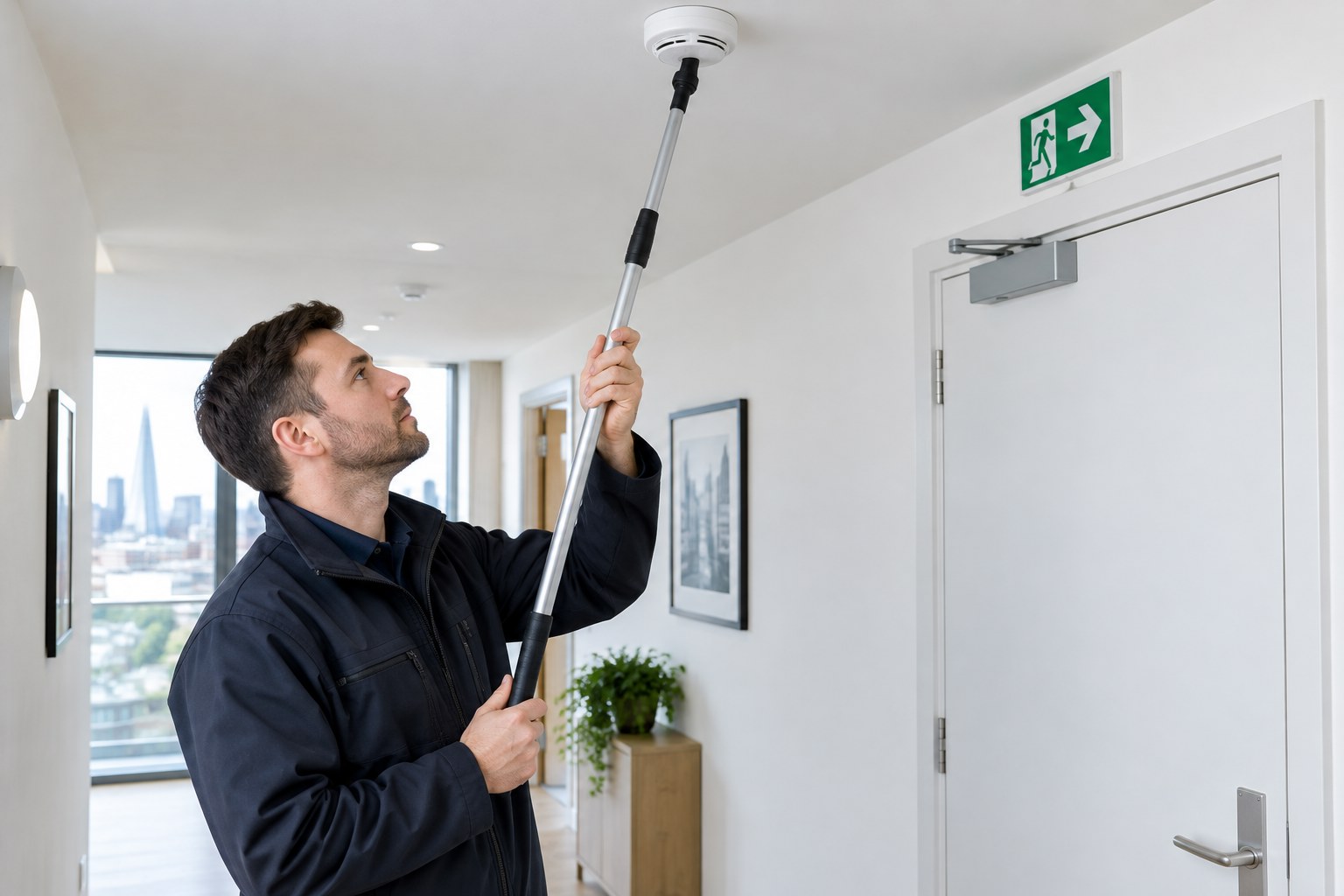
A typical fire safety inspection by Landlord Sure covers:
- Alarm testing. Every smoke, heat and carbon monoxide alarm is tested, and its age, type and position are recorded. Alarms near the end of their life are flagged.
- Interlinking. Where alarms are interlinked, the engineer checks that triggering one sounds the others.
- Fire doors. Doors are checked for gaps, damaged seals, faulty closers, missing signage and hinges that need attention.
- Emergency lighting. Lights along escape routes are tested to confirm they come on when the mains supply fails.
- Fire-fighting equipment. Extinguishers and fire blankets are checked for presence, service dates and correct type.
- Escape routes. Corridors and stairs are checked to make sure they are clear and not used for storage.
- Report and certificate. You receive a digital report with the results, photos where relevant and any recommended actions.
Fire safety certificate vs fire risk assessment
These two documents are often confused, but they do different jobs. Many landlords need both.
| Fire safety certificate | Fire risk assessment (FRA) | |
|---|---|---|
| What it does | Confirms that fire safety equipment is present and working | Identifies fire hazards, who is at risk and what precautions are needed |
| Legal status | Good practice evidence of compliance | Legal requirement for HMOs and common parts of multi-occupied buildings |
| Focus | Alarms, doors, emergency lighting, extinguishers | The whole building, its use, its occupants and its management |
| Typical frequency | Annually and at each new tenancy | Reviewed regularly, usually annually, and after significant changes |
| Landlord Sure price | From £60 | Communal areas from £134.99 |
Put simply, the fire risk assessment tells you what fire precautions your building needs, and the fire safety certificate confirms those precautions are working. Find out more about our domestic fire risk assessments and commercial fire risk assessments.
How long does a fire safety certificate last?
Because a fire safety certificate is not a single statutory document, there is no fixed legal expiry date. A certificate reflects the condition of the property on the day of the inspection, so most landlords treat it as valid for 12 months. In practice, we recommend an inspection:
- Every 12 months as a routine check
- At the start of each new tenancy, when the law already requires you to check alarms are working
- After building work, such as a loft conversion, new partitions or a new kitchen
- When the use of the property changes, for example converting a family let into an HMO
Some equipment has its own recommended service intervals. Emergency lighting should be tested regularly, with a full-duration test each year, and fire extinguishers should be serviced annually by a competent person. Our emergency lighting certificate and fire extinguisher service cover these.
How much does a fire safety certificate cost?
Costs depend mainly on the number of alarms and the type of building. Landlord Sure’s fixed London prices are:
| Service | Typical property | Price |
|---|---|---|
| Fire safety certificate, 1 to 3 alarms | Studios, flats and smaller homes | £60 |
| Fire safety certificate, 4 to 5 alarms | Larger flats and family houses | £84 |
| Fire safety certificate, 6 to 8 alarms | Larger homes and small HMOs | £120 |
| Fire safety certificate, 9 to 12 alarms | HMOs and blocks with communal alarm systems | £165 |
| Each additional alarm over 12 | Larger buildings | £17 per alarm |
| Fire door inspection | Seals, closers, gaps, hinges and signage | £119.99 |
You can often save time by booking a fire safety certificate alongside your gas safety certificate or EICR, so your tenants only need to provide access once.
How to get a fire safety certificate: step by step
- Count your alarms and note any fire doors, emergency lights or extinguishers, so you can choose the right package.
- Book online through our online booking page or call us.
- Arrange access with your tenants, giving them proper notice. The engineer needs to reach every alarm and fire door.
- Inspection day. Most homes take under an hour. Larger HMOs and blocks take longer.
- Receive your certificate digitally, with any defects and recommendations clearly listed.
- Fix any issues promptly and keep the certificate with your other compliance records.
Common fire safety issues we find
- Missing alarms on a storey, often a loft room or basement added after the alarms were fitted.
- Alarms past their replacement date. Most manufacturers recommend replacing smoke alarms after about 10 years.
- No carbon monoxide alarm in a room with a boiler or wood burner.
- Fire doors propped open or fitted with closers that no longer shut the door fully.
- Damaged or missing intumescent seals and smoke seals on fire doors.
- Escape routes used for storage, such as bikes, bins and furniture in communal hallways.
- Emergency lights that fail on test because batteries have reached the end of their life.
- Expired extinguisher service dates or the wrong type of extinguisher for the area.
Penalties for fire safety failures
The consequences of ignoring fire safety can be serious:
- Smoke and carbon monoxide alarms: councils can serve a remedial notice and impose a civil penalty of up to £5,000 if the landlord fails to comply.
- Fire Safety Order breaches: responsible persons can face unlimited fines, and serious cases can lead to imprisonment of up to two years.
- Housing Act and HMO breaches: councils can prosecute or issue civil penalties, and failing to meet HMO management duties can also put a licence at risk.
- Insurance: insurers may refuse or reduce a claim if fire precautions were not maintained.
Above all, working fire safety measures save lives. A certificate is the easiest way to show that yours are in place.
Frequently asked questions
Do landlords need a fire safety certificate?
There is no single law requiring a document called a fire safety certificate for most rented homes. However, landlords must meet fire safety duties such as fitting and checking smoke and carbon monoxide alarms, and many must have a fire risk assessment. A fire safety certificate is the best evidence that these duties are met.
What replaced fire safety certificates?
The Regulatory Reform (Fire Safety) Order 2005 replaced fire certificates issued under the Fire Precautions Act 1971. Since 1 October 2006, the responsible person must carry out and act on a fire risk assessment instead.
How much is a fire safety certificate?
Prices depend on the number of alarms. Landlord Sure’s London prices start at £60 for 1 to 3 alarms, rising to £165 for 9 to 12 alarms, with fire door inspections from £119.99.
How long is a fire safety certificate valid for?
There is no legal expiry date, but most landlords renew every 12 months and at the start of each new tenancy.
Who can issue a fire safety certificate?
A competent person with suitable training and experience in fire safety equipment, such as a qualified fire safety engineer or assessor.
Do I need a fire risk assessment for a single flat?
Usually not for the inside of a flat let to one household. But the common parts of the building, such as shared hallways and stairs, do need one, normally arranged by the freeholder or managing agent.
Are interlinked smoke alarms required?
Interlinked alarms are not required in every rented home in England, but they are commonly needed in HMOs and are often recommended in larger properties. Your fire risk assessment or HMO licence conditions will say what is needed.
How long does a fire safety inspection take?
Most flats and houses take under an hour. HMOs and blocks with communal systems take longer, depending on the number of alarms and doors.
Do I need a new certificate for every tenancy?
You must check that alarms are working on the first day of every new tenancy. Many landlords book a fire safety inspection at each changeover so they have dated evidence on file.
Is a fire safety certificate the same as a fire risk assessment?
No. A fire risk assessment identifies the risks and the precautions needed. A fire safety certificate confirms the precautions, such as alarms and fire doors, are working.
Do the rules apply to letting agents?
Letting agents who manage a property on the landlord’s behalf can share responsibility for compliance, so agents should keep fire safety records for every managed property.
Book your fire safety certificate with Landlord Sure
Fixed prices from £60, qualified fire safety professionals and digital certificates. We cover London and surrounding areas, and you can add a fire door inspection, emergency lighting certificate or fire risk assessment in the same booking.
Sources: GOV.UK – Smoke and carbon monoxide alarms: guidance for landlords; GOV.UK – Fire Safety (England) Regulations 2022: fire door guidance; GOV.UK – Fire safety responsibilities under section 156 of the Building Safety Act 2022; London Fire Brigade – Fire Safety (England) Regulations 2022. Information checked October 2026. This guide is general information, not legal advice.